

Today is the last day of July and I feel compelled to write a blog post just so I can say I posted something in July; I hate to let a whole month go by without writing something, I just haven’t found the time.
There’s a culture of busyness right now, where people feel like being busy makes you a better person, or an important person—being so busy you routinely run out of time for a shower is, for some reason, seen as a status symbol or a sign of success. There’s a separate culture of people who say that being constantly “busy” is actually counter-productive. I’m going to jump on board with these people.
Florida psychologist Anders Ericcson conducted a study to find out what it took to be the best at something. He researched the behaviours of the most successful musicians and found that the best musicians were the ones who practiced the hardest for no more than 90 minutes and often took breaks and naps. While this obviously isn’t the be-all and end-all solution to the busy problem (and granted, the “best” musicians are probably [positive] freaks of nature who were born with a cello in one hand and a bow in the other, far from your Average Joe Citizen), it does suggest that overworking your brain and filling it with tasks for every one of your waking hours is more of a hindrance than not.
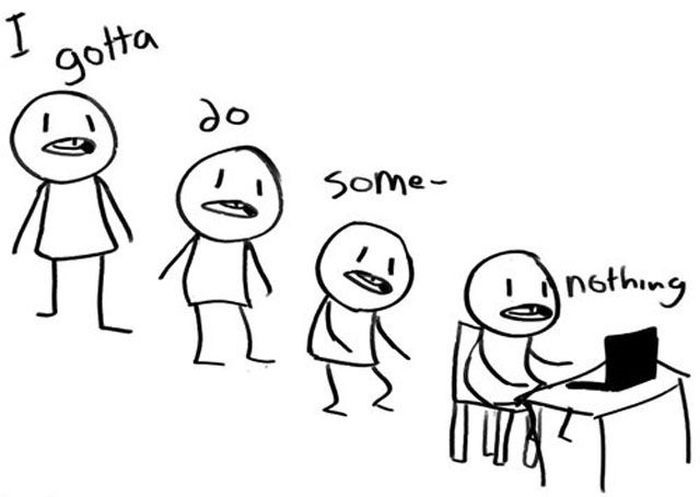
Now, I’m no Florida psychologist, but I’ve lived 29 years and I can attest that busy isn’t better—having said that, it doesn’t mean that clearing your schedule isn’t easier said than done. Start simple, take a coffee or tea break during your work day. Wait in the kitchen for five minutes while the kettle boils, let your mind relax, wander.
When I was a kid, and I think this is true for most people, all I did all day was imagine things. Imagine possibilities, imagine stories, imagine people. This was because the existence of a child consists of literally nothing but free time. Sure, there’s the occasional school day, or family function, but generally kids are given the freedom to simply exist in their environments, with a little guidance from the big people. When I was a teenager and faced with the task of being good at high school, having a job, having a social life, and attempting to nurture some sort of interesting personality that would effortlessly make me good at all three, I found myself having a mini existential crisis: I lost my imagination.
I remember being maybe 8 or 9-years-old and sitting in my parents’ bedroom, clacking away on the keys of our 286 computer, writing a story about Santa Claus crash-landing in a forest and losing track of some of his reindeer, and on Christmas Eve—oh no! I can’t quit remember how the story went but I do recall there was some mention of radar to track the sleigh’s flight path. That’s darn creative. As a teen, I remember holding this story on a pedestal; I’d think of it whenever I was feeling creatively blocked and I’d think: I’m not creative any more. Eventually, I realised that I’d just become creative in other ways, and that my imagination wasn’t dead. But being a busy teenager with homework, a job, after-school sports, school clubs, and trying be funny and cool and seem totally carefree wasn’t giving my brain any free time to be creative.
That same idea applies now to my adult life (and everyone else’s), and it’s what Ericcson realised from his research: giving your brain time to relax is actually going to make you more productive and successful. Journalist Brigid Schulte wrote a book on the subject and she agrees, “In the breaks, that’s when the ‘aha-moment’ comes.” Just consider the last time you were on public transit and your cell phone died and you didn’t have a book or the newspaper or an MP3 player, you just ended up staring out the window until you reached your destination. That window-staring-time was good, wasn’t it? Your brain probably relaxed, maybe it starting thinking about what you wanted to eat later, or what your weekend plans might consist of. Maybe you’ll go to that new downtown pub you saw opened recently. Maybe you’ll find a new cider that you really like. You wonder how hard it would be to make your own cider. It’s just apples, right? You could plant an apple tree in your yard and start harvesting fruit. You could make a seasonal cider and give it away to all your friends as gifts. You’d call it City Cider. The label would be so cute, one of your friends would design it for you, along with a banner for your new City Cider website. You’d be so quaint and chic that you’d make it into all the hip blogs and magazines. Pretty soon the city’s best restaurants will be stocking your City Cider and you’d be hanging out with cool chefs and cool people. And even though your one tree in the backyard operation has now become a small orchard in a cute town near Georgian Bay (also featured in a magazine), you’re still the same down-to-earth, takes-public-transit, person. And then your stop is called and you realised you still have the capacity to imagine.
So, while busy isn’t better, that doesn’t mean that laziness should prevail, either. Happy medium, people. I often think about writing blog posts but rarely follow through because I think I’m either too busy or I don’t think I have anything to say. The answer, for me, is just to open a blank page and see what happens. The busy thing is a lie. I often have plans for every night of the week but that my tea date with girlfriends isn’t going to take eight hours. And my Netflix viewing history would definitely suggest a lot more free time than I might have previously been willing to recognize. The technique “Just do it and see what happens” is one I learned from my Sittee (grandma). At rest stops during long road trips she’d ask me if I had to pee, I’d always say no (because kids never have to pee, especially not if something exciting might happen in the two minutes we’re in the bathroom). Her next move would always be to take me to bathroom anyway, she’d say “As soon as you sit on the toilet you’ll have to pee.” And dammit, she was right. I have adopted this technique to many aspects of my life, including writing. Open a blank page. A writer can’t resist a blank page. Sooner or later (hopefully sooner because I’m really busy) an idea strikes and a story is born.

 outloudkat, since 2009