
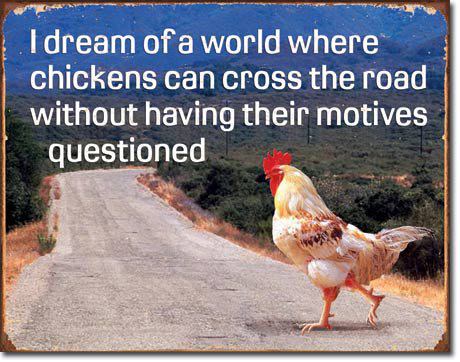
 This might sound wild, possibly unbelievable, but it was only recently, maybe three years ago, that I actually understood, or believed I understood, the joke “Why did the chicken cross the road?” When you hear something so often growing up, it just becomes ingrained in your mind, it becomes something that just is, no need to explain it, no need to even think that it needs explaining, it just exists and it always has and that’s just fact. This is how I thought of the chicken joke. I knew it was a joke, I knew how to tell the joke, I knew the “punchline” to the joke. I didn’t consider it particularly humorous but then, who am I to question the quality of such an ancient and well-lauded joke such as the chicken crossing the road?
I’m not sure how I even came to start analysing the joke, but at some point in my 20s it suddenly dawned on me that the chicken was simply crossing the road to get to the other side. It was just that straight forward. Why else does someone cross a road but to cross the road? To go from one side to the other. It’s so simple that it escaped me for decades. I then proceeded to laugh at how myself for “not getting it” for so long. I have since learned that there are other interpretations out there, such as “the other side” being the afterlife. The chicken crossed the road so he could get hit by a car and die and then “cross over,” as it were, to the other side. This seems to be grasping at a few non-existent straws, but since it took me 20+ years to decipher my own meaning I won’t be casting judgement too harshly.
It’s probably the first joke any of us ever hear or learn, and it’s not funny, is it? When you’re a kid and you hear it for the first time you probably laugh, because up until that point you’ve been told that a joke is something funny. And when something’s funny you’re supposed to laugh. As a kid you can’t extrapolate that not all jokes are funny or not all things you say that you think are funny are jokes.
For example, one of the only times in my life that I ever babysat I was looking after 2 kids, I was probably 15 and they were probably 6 and 7, and the entire car ride to their house was one long knock knock joke gone horribly awry. They, of course, were peeing their tiny pants with laughter, and I was smiling broadly like an idiot babysitter who will do anything to just keep the kids from crying and screaming for their parents. Their joke went something along the lines of:
Knock, knock.
Who’s there?
Peppers.
Peppers who?
Peppers and bananas…because…there was a monkey that would…um…Peppers and bandannas…um…when you go inside…there’s a monkey, okay? Okay, so the monkey and the hippo. No, the giraffe. The peppers and the giraffe…er…monkey…because his mum was like “No cookies before dinner!”
Hysterical laughter ensues. And I dare anyone to try to get those kids to repeat the same joke twice. It’ll never happen. Because they just make them up! On a side note, if you ask a kid “Do you know any jokes?” and he says yes and proceeds to launch into one of these unjoke ramble-fests, how is that not considered lying? He clearly did not know any jokes. He should have said no and we all could have moved on.
Back to chickens, however, for many people the question still remains, why did it cross the road? And why is this all-too-common question even considered a joke? An Internet hero–who goes, aptly, by the name JokeExplainer–suggests the simplicity of the joke is what makes it a joke. That, ironically, it’s the unpredictability of the most mundane answer that makes it funny. I fear, though, that overexposure throughout the years has ruined what may have actually been a very clever joke at one time. Whatever original purpose this joke strove to achieve is lost and gone forever.
JokeExplainer (JE, I shall call him) goes on to suggest that it’s not really a joke at all, but rather a riddle. He (I’m actually only assuming that JE is a he, as he lurks in the ambiguity of the Internet, I’m not sure) notes that the “joke” was first told at least half a century before the invention of the automobile, so crossing the road wouldn’t have been considered a life or death gamble. If we are to believe this Internet stranger, this would explain away the afterlife/other side theory.
JE goes on to say, “When someone asks you ‘Why did the chicken cross the road?’ you’re supposed to imagine all the myriad reasons a chicken would need to go someplace. A chicken might need to escape a predator, or to get back to a hen house, or to eat a bug he saw, or who knows what. The listener is supposed to assume that such a bizarre question must have an interesting answer.” So, at this suggestion, it’s basically a trick question. “The punchline is absurd because it answers the question without revealing the motivation of the chicken whatsoever.”
Because the joke has been told so many times and is so well known, it has lost the ability to actually make people think. It’s probably one of the most well known punchlines of all time. Everyone automatically says “To get to the other side,” there is no reason for anyone to actually wonder why a chicken would want to cross a road.
JE provides an example of an opposite style “joke” with “Why did you fly to London last weekend?” “Because it’s much too far to swim, idiot.” He adds “Of course it’s too far to swim. The question wasn’t really about why the person chose to fly 3,000 miles rather than swim across the ocean. The listener expects an answer explaining the actual reason for the trip, but the answer given is ridiculously obvious. That’s the joke.”
In the case of the chicken joke, the listener is expecting a ridiculous answer. Something funny even (the audacity). And what they get in return is so uninteresting and unfunny that the joke is actually on the listener. They’ve been duped. I would imagine in its heyday, this joke garnered more laughs for the joke teller than for the listener.

 outloudkat, since 2009